
Longevity Synergy · The Botanicals
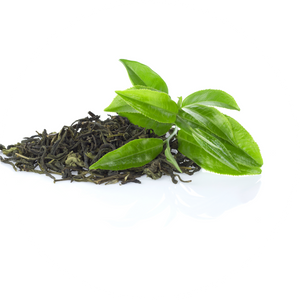
Green Tea
Green tea's catechins help support the body's own antioxidant defenses and healthy metabolism as you age.†
Why It's In The FormulaOne of the most studied botanicals in longevity science
Green tea (Camellia sinensis) is one of the most studied botanicals in the longevity space, concentrated in the formula for its polyphenol catechins, chiefly epigallocatechin-3-gallate (EGCG). These compounds help support the body's natural antioxidant systems, help maintain healthy metabolic function, and help engage several of the cellular pathways associated with healthy aging.† We include a standardized catechin source so each serving delivers a consistent, meaningful amount of EGCG.†
A note on the evidence: much of the pathway research below comes from laboratory (cell) and animal studies, which show how a compound is thought to work. We label the evidence level honestly for each area so you can weigh it yourself.
What The Science SupportsMetabolism & antioxidant support
Green tea catechins help support healthy body composition and metabolic function, and human systematic reviews of randomized trials report modest, consistent effects on anthropometric measures when catechins are taken regularly.† EGCG and related catechins also help support the body's own antioxidant defenses, helping maintain a healthy balance against everyday oxidative stress.† Effects in people tend to be modest and are most evident alongside a healthy diet and activity.†
How It Connects To Your Longevity PathwaysGreen Tea & the master pathways
Longevity Synergy is built around cellular pathways central to healthy aging. Here is how Green Tea engages each one, with the research behind it.
Nrf2 Activation Early human
Nrf2 is a master regulator that switches on the body's own antioxidant and detoxifying enzymes. EGCG helps promote Nrf2 activity, which helps support the cell's built-in antioxidant defenses and helps maintain a healthy response to everyday oxidative stress. Much of the detailed mechanism comes from cell and animal work, but a small human trial has reported increased Nrf2 activity with green tea supplementation.†
AMPK Activation Preclinical, consistent
AMPK is a cellular energy sensor that helps maintain healthy energy balance and metabolism, becoming more active when cells need to make or conserve energy. In laboratory and animal studies, EGCG helps promote AMPK activation, which helps support healthy glucose and fat metabolism.† These findings are consistent across preclinical models, though direct human confirmation of the AMPK step is still limited.
mTOR Modulation & Autophagy Preclinical
Autophagy is the cell's natural housekeeping process for clearing and recycling worn-out components, and it is held in check by the mTOR pathway. In cell studies, EGCG helps modulate mTOR signaling and helps support healthy autophagy, part of how cells maintain their own quality control.† This evidence is currently preclinical, so it reflects mechanism rather than a proven human outcome.
Sirtuin Activation Early human
Sirtuins (such as SIRT1) are enzymes that help regulate cellular stress responses, metabolism, and healthy aging pathways. In animal and cell studies, EGCG-rich green tea extract helps promote SIRT1 activity alongside AMPK, helping support healthy metabolic and mitochondrial function.† An early human trial has also reported higher circulating Sirtuin-1 with green tea supplementation, though human data remain limited.†
Telomere Preservation Early human
Telomeres are the protective caps on the ends of chromosomes that tend to shorten with age. In human research, regular green tea intake has been associated with longer leukocyte telomere length, and a small randomized trial in women reported telomere lengthening with green tea supplementation, suggesting it may help support the body's natural maintenance of these protective caps.† The human evidence is early and largely observational, so it points to an association rather than a proven cause-and-effect outcome.
At A GlanceEvidence summary
| Area | What it supports† | Evidence level |
|---|---|---|
| Metabolism & antioxidant | Healthy body composition, metabolism, and the body's own antioxidant defenses | Moderate human |
| Nrf2 (antioxidant defense) | The cell's built-in antioxidant and detoxifying response | Early human |
| AMPK (energy sensing) | Healthy energy balance and glucose/fat metabolism | Preclinical, consistent |
| mTOR & autophagy (cell renewal) | The cell's natural housekeeping and quality control | Preclinical |
| Sirtuins & telomeres (cellular aging) | Healthy-aging pathways and natural telomere maintenance | Early human |
One Capsule · Eight Botanicals
Green Tea is one of eight, working in synergy
Each botanical in Longevity Synergy was chosen to support the master longevity pathways together.†
Explore Longevity SynergySourcesSelected research
- Effect of green tea catechins with or without caffeine on anthropometric measures: a systematic review and meta-analysis. American Journal of Clinical Nutrition, 2010 (meta-analysis) https://pubmed.ncbi.nlm.nih.gov/19906797/
- Effects of green tea extract supplementation on body composition, obesity-related hormones and oxidative stress markers: a GRADE-assessed systematic review and dose-response meta-analysis of RCTs. British Journal of Nutrition (meta-analysis) https://www.cambridge.org/core/journals/british-journal-of-nutrition/article/effects-of-green-tea-extract-supplementation-on-body-composition-obesityrelated-hormones-and-oxidative-stress-markers-a-gradeassessed-systematic-review-and-doseresponse-metaanalysis-of-randomised-controlled-trials/5F7DCFF04BE51796D39A6CC5B0A3089A
- Modulation of Nrf2-mediated antioxidant and detoxifying enzyme induction by the green tea polyphenol EGCG. Food and Chemical Toxicology, 2008 (cell) https://pubmed.ncbi.nlm.nih.gov/18082923/
- Combined effects of green tea supplementation and eccentric exercise on Nrf2 activity. European Journal of Applied Physiology, 2023 (human RCT) https://pmc.ncbi.nlm.nih.gov/articles/PMC10786739/
- Epigallocatechin-3-gallate suppresses hepatic gluconeogenesis through 5'-AMP-activated protein kinase. Journal of Biological Chemistry, 2007 (animal) https://pubmed.ncbi.nlm.nih.gov/17724029/
- EGCG Reduces Obesity and White Adipose Tissue Gain Partly Through AMPK Activation in Mice. Frontiers in Pharmacology, 2018 (animal) https://pmc.ncbi.nlm.nih.gov/articles/PMC6262053/
- EGCG Promotes Autophagy-Dependent Survival via Influencing the Balance of mTOR-AMPK Pathways upon Endoplasmic Reticulum Stress. Oxidative Medicine and Cellular Longevity, 2018 (cell) https://pmc.ncbi.nlm.nih.gov/articles/PMC5831959/
- EGCG protects vascular endothelial cells from oxidative stress via the autophagy-dependent PI3K-AKT-mTOR pathway. Annals of Translational Medicine, 2020 (cell) https://pmc.ncbi.nlm.nih.gov/articles/PMC7154459/
- EGCG-Rich Green Tea Extract Ameliorates Fatty Liver and Weight Gain in Mice by Activating the SIRT1 and AMPK Pathway. American Journal of Chinese Medicine, 2018 (animal) https://pubmed.ncbi.nlm.nih.gov/29595075/
- Effects of high intensity interval training and green tea supplementation on serum Sirtuin-1 and PGC-1 alpha in overweight women. Science & Sports, 2017 (human RCT) https://www.sciencedirect.com/science/article/abs/pii/S0765159716301496
- Green tea supplementation promotes leukocyte telomere length elongation in obese women. Molecular Nutrition & Food Research, 2018 (human RCT) https://pubmed.ncbi.nlm.nih.gov/29974764/
- Associations of green tea, coffee, and soft drink consumption with longitudinal changes in leukocyte telomere length. Scientific Reports, 2023 (observational) https://pmc.ncbi.nlm.nih.gov/articles/PMC9832020/
†These statements have not been evaluated by the Food and Drug Administration. This product is not intended to diagnose, treat, cure, or prevent any disease. Much of the pathway research described above is from laboratory and animal studies and indicates biological mechanisms rather than proven human outcomes.
← Back to The Science of Longevity Synergy