
Longevity Synergy · The Botanicals
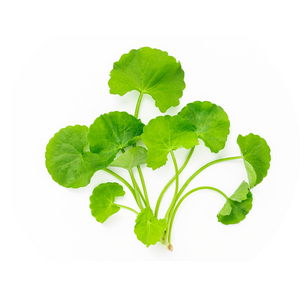
Gotu Kola
Centella asiatica, the traditional longevity leaf, studied for how it supports healthy cognition and the cellular processes tied to graceful aging.†
Why It's In The FormulaA botanical with a long history and a growing evidence base
Gotu kola has been used in traditional wellness practices for centuries and nicknamed the longevity leaf. Modern laboratory and animal research has focused on its triterpene compounds, asiatic acid, madecassoside, and asiaticoside, which appear to engage several of the same cellular pathways that longevity scientists study. In Longevity Synergy, gotu kola is included to help support steady mental clarity, healthy circulation, and the cellular resilience that underlies vitality as we age.†
A note on the evidence: much of the pathway research below comes from laboratory (cell) and animal studies, which show how a compound is thought to work. We label the evidence level honestly for each area so you can weigh it yourself.
What The Science SupportsCognition & healthy aging
The most developed human research on gotu kola looks at cognitive function in older adults. A Phase 1 randomized, double-blind clinical trial in cognitively impaired older adults examined a standardized Centella asiatica product and its active compounds. Independent scientific reviewers at the Alzheimer's Drug Discovery Foundation's Cognitive Vitality program have summarized the broader body of Centella asiatica cognition research, and ongoing trials at Oregon Health & Science University continue to study it in older adults. Together these support gotu kola's role in helping maintain healthy cognitive function.†
How It Connects To Your Longevity PathwaysGotu Kola & the master pathways
Longevity Synergy is built around cellular pathways central to healthy aging. Here is how Gotu Kola engages each one, with the research behind it.
Nrf2 Activation Preclinical, consistent
Nrf2 is the body's master switch for its own antioxidant defenses. In laboratory studies, a standardized Centella asiatica extract activated the Nrf2/HO-1 signaling pathway in brain immune (microglial) cells, and its compound asiatic acid enhanced Nrf2 signaling to protect cells from oxidative damage. In animal models, an intact Nrf2 pathway was actually required for gotu kola's cognitive benefits during aging, tying this pathway directly to the healthy-aging effect.†
AMPK Activation Preclinical
AMPK is a cellular energy sensor that helps balance metabolism. In laboratory and animal research, asiatic acid from gotu kola activated the AMPK signaling pathway, and reviews of Centella asiatica's metabolic actions describe engagement of this energy-regulating pathway. This supports its role in healthy energy metabolism already within a normal range.†
mTOR Modulation & Autophagy Preclinical
mTOR helps govern the balance between cellular growth and cellular housekeeping (autophagy, the clean-up of worn-out cell components). A 2026 scientific review of gotu kola's geroprotective potential describes its modulation of mTOR-linked autophagy and related cellular-renewal processes. This supports healthy cellular renewal.†
Sources: [9]
Sirtuin Activation Preclinical
Sirtuins are longevity enzymes involved in cellular repair and stress resistance. Reviews of Centella asiatica's mitoprotective and neuroprotective actions describe engagement of sirtuin-linked repair and mitochondrial-resilience pathways, and the geroprotective review catalogs its effects on sirtuin-related cellular-aging signaling.†
Telomere Preservation Early / preliminary
Telomeres are protective caps on our chromosomes that shorten as cells divide. A randomized, double-blind, placebo-controlled human trial of a botanical formula that included Centella asiatica reported effects on telomere length in adults, and the geroprotective review discusses gotu kola's relationship to cellular senescence and telomere-linked aging. Human evidence for gotu kola specifically is still preliminary, so we describe this as an area of emerging research.†
At A GlanceEvidence summary
| Area | What it supports† | Evidence level |
|---|---|---|
| Cognitive function | Helping maintain healthy cognition & mental clarity | Early human trials + reviews |
| Nrf2 / antioxidant defense | Supporting the body's natural antioxidant defenses | Cell & animal |
| AMPK / energy metabolism | Supporting healthy energy metabolism | Cell & animal |
| mTOR / autophagy | Supporting healthy cellular renewal | Review (cell & animal) |
| Sirtuins / repair | Supporting cellular repair & stress resistance | Review (cell & animal) |
| Telomere / cellular aging | Supporting healthy cellular aging | Preliminary / emerging |
One Capsule · Eight Botanicals
Gotu Kola is one of eight, working in synergy
Each botanical in Longevity Synergy was chosen to support the master longevity pathways together.†
Explore Longevity SynergySourcesSelected research
- Pharmacokinetics and Pharmacodynamics of a Standardized Centella asiatica Product in Cognitively Impaired Older Adults: A Phase 1, Double-Blind, Randomized Clinical Trial. Antioxidants, 2022 (human RCT) https://www.mdpi.com/2076-3921/11/2/215
- Centella Asiatica (Gotu Kola) & Your Brain, Cognitive Vitality. Alzheimer's Drug Discovery Foundation (review) https://www.alzdiscovery.org/cognitive-vitality/ratings/centella-asiatica
- Safety and Target Engagement of Centella asiatica in Cognitive Impairment. Oregon Health & Science University (human trial) https://www.ohsu.edu/school-of-medicine/neurology/safety-and-target-engagement-centella-asiatica-cognitive-impairment
- The Standardized Extract of Centella asiatica and Its Fractions Regulate the Nrf2/HO-1 Signaling Pathway. J Alzheimers Dis, 2024 (cell) https://journals.sagepub.com/doi/abs/10.3233/JAD-230875
- Asiatic acid enhances Nrf2 signaling to protect cells from oxidative damage. Pharmacol Res, 2017 (cell) https://pubmed.ncbi.nlm.nih.gov/28110191/
- Loss of NRF2 is required for the cognitive-enhancing effects of Centella asiatica during aging. Redox Biol / PMC (animal) https://pmc.ncbi.nlm.nih.gov/articles/PMC7920997/
- Asiatic Acid Protects against Cardiac Hypertrophy through Activating AMPK Signalling Pathway. Int J Biol Sci (animal) https://www.ijbs.com/v12p0861.htm
- Centella asiatica and its bioactive compounds: managing hyperglycemia and associated disorders. Discover Plants, 2024 (review) https://link.springer.com/article/10.1007/s44372-024-00070-7
- Geroprotective Potential of Centella asiatica: Modulation of Cellular Aging. Nutrients, 2026 (review) https://www.mdpi.com/2072-6643/18/11/1649
- Mitoprotective Effects of Centella asiatica: Anti-Inflammatory and Neuroprotective Opportunities. Front Pharmacol, 2021 (review) https://www.frontiersin.org/journals/pharmacology/articles/10.3389/fphar.2021.687935/full
- Efficacy of a dietary supplement derived from edible plants on telomere length in adults: a randomized, double-blind, placebo-controlled trial. Food Sci Nutr, 2024 (human RCT) https://onlinelibrary.wiley.com/doi/full/10.1002/fsn3.3851
†These statements have not been evaluated by the Food and Drug Administration. This product is not intended to diagnose, treat, cure, or prevent any disease. Much of the pathway research described above is from laboratory and animal studies and indicates biological mechanisms rather than proven human outcomes.
← Back to The Science of Longevity Synergy